
LCANZ Summit 2026 Highlights: Communicating LCA and EPD Results
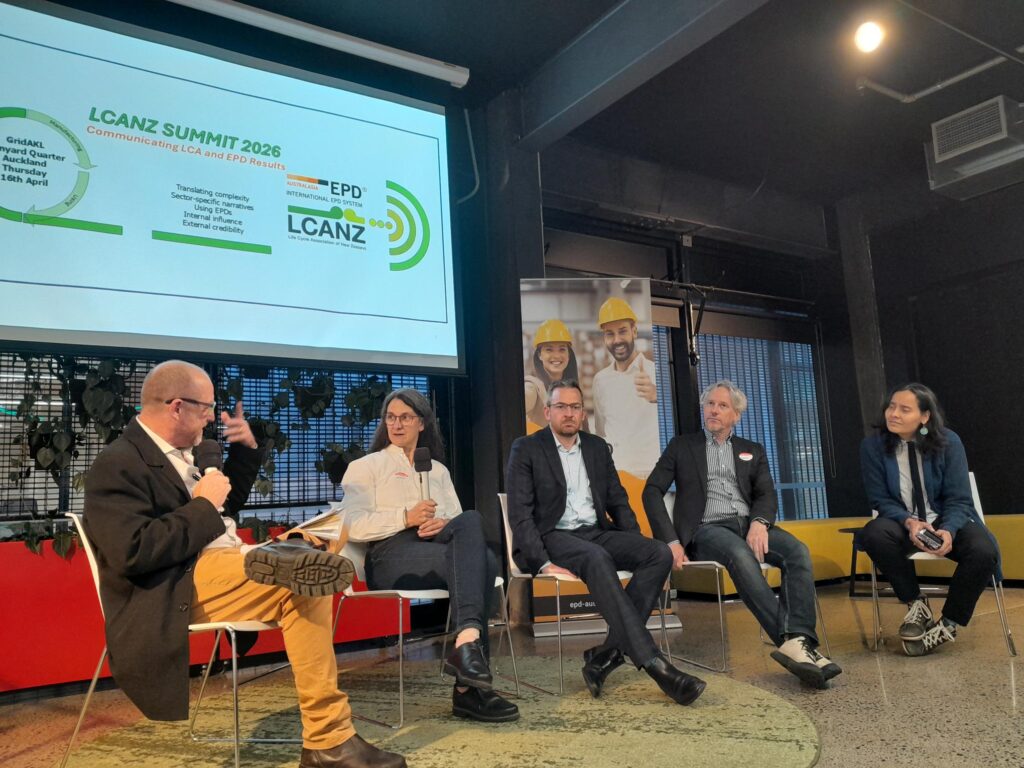
LCANZ, in partnership with EPD Australasia, successfully hosted the LCANZ Summit 2026, bringing together close to 50 LCA practitioners, industry users, and sustainability professionals from across Aotearoa New Zealand.
This year’s Summit focused on a timely and increasingly critical theme: communicating LCA and environmental product declaration (EPD) results effectively. A consistent message throughout the day was that generating robust data is no longer enough. There is an equally important responsibility to translate that data into insights that are meaningful and actionable for different audiences.
LCANZ President and CEO of thinkstep-anz Barbara Nebel set the tone early, highlighting how a single dataset can be communicated in multiple ways—from academic outputs to industry-focused summaries—each tailored to its intended audience. This framing underscored both the challenge and opportunity facing the LCA community.
Kelly Taylor, CEO of EPD Australasia provided an update on the growth of EPDs, noting that more than 3,900 EPDs have now been published, with New Zealand leading globally on a per capita basis. She also highlighted upcoming efforts to improve accessibility, including reduced registration fees for small and medium-sized enterprises (SMEs).
Expanding demand drivers were discussed by Stephen Mitchell, Director at EPD Australasia, who pointed to both local influences such as Green Star and international developments, including policies like California’s Buy Clean Act, which are increasingly bringing EPDs into export market considerations.
Looking ahead, Andrew D Moore (Founder and Principal Sustainability Scientist at Life Cycle Logic) introduced emerging developments in pre-verified tools designed to support faster and more scalable EPD generation.
Real-world applications of LCA and EPDs featured strongly throughout the programme. Edwin Massey—General Manager Sustainability at NZ Wine emphasised that sustainability data is now essential for market participation, supporting both credible communication and tangible decarbonisation efforts within the wine sector.
A joint session by Delphine David (Head of Partnerships at Bravetrace) and Emily Townsend (Service Director at thinkstep-anz) explored the use of renewable energy certificates in LCA and EPDs. The session highlighted the importance of applying the market-based approach for electricity and accounting for residual grid mixes in line with current greenhouse gas reporting and EPD standards.
Innovation in practice was demonstrated by Lina Maria Ladron De Guevara (Senior Sustainability Specialist) and Amelia Beckley (Product Development Engineer) of Fisher & Paykel Healthcare, who showcased the use of modular ‘building block’ approaches to streamline LCA modelling, illustrated through a creative Lego-based analogy that resonated strongly with attendees.
The importance of translating data into insights for decision-makers was reinforced by Robert Lyall—Decarbonisation Programme Director at WSP, who noted that carbon data alone does not drive change unless it is framed in a way that connects with senior leadership and business priorities.
A particularly notable moment came from Phoebe Mitch (Sustainability and Compliance Business Partner at Laminex NZ), who reflected on over two decades of LCA practice within the company. The presence of past and present sustainability leaders highlighted the long-term nature of LCA implementation and the importance of continuous improvement.
In closing, Gustavo Moraga—Senior Sustainability Specialist at thinkstep-anz emphasised that while EPDs are powerful due to their standardised and concise format, their full value is only realised when results are clearly interpreted and communicated.
Key takeaway:
LCA is no longer just about producing accurate results—it is about ensuring those results are understood, trusted, and used to drive meaningful change.